



Primary Agricultural Credit Societies (PACS) are the grass root level arms of the short-term co-operative credit structure. PACS deals directly with the rural (agricultural) borrowers, disburses loans and collects repayments of loans and undertakes distribution and marketing functions. It operates at the base level, serving as the lowest tier in the three-tier cooperative credit structure. The other two tiers are District Central Cooperative Banks (DCCBs) and State Cooperative Banks (SCBs). In India, the first PACS was established in 1904, following the enactment of the Cooperative Credit Societies Act.
Three different types of cooperative banks function in India – Tier 1, Tier 2 and Tier 3. The functionality of each type of cooperative bank is given below.
Tier-1: State Cooperative Banks – They serve as the highest governing bodies for all cooperative banks within a specific State. These banks play a crucial role in establishing a link between cooperative banks and the Reserve Bank of India.
Tier-2: District/Central Cooperative Banks – These organizations function at the district level and their main purpose is to allocate funds to Primary Agricultural Credit Societies.
Tier-3: Primary Agricultural Credit Societies (PACSs) – These form the foundation of the hierarchical structure. They are mostly in rural areas and directly serve the local population by providing services such as loans and opening deposit accounts.
PACS are registered under the Cooperative Societies Act and are regulated by state governments.
The following is the Organizational Structure of PACS:
General Body of PACS: Exercise the control over Board as well as Management.
Management Committee: Elected by the general body to perform the work as prescribed by society’s rules, acts, and bye-laws.
Chairman, Vice-Chairman, and Secretary: Work for the benefit of the members by performing their roles and duties as assigned to them.
Office Staff: Responsible for performing day-to-day work.
PACS are being mandatorily audited at least once a year by a person authorized by the Registrar of Cooperative Societies (RCS) or a Chartered Accountant appointed by the society’s committee.
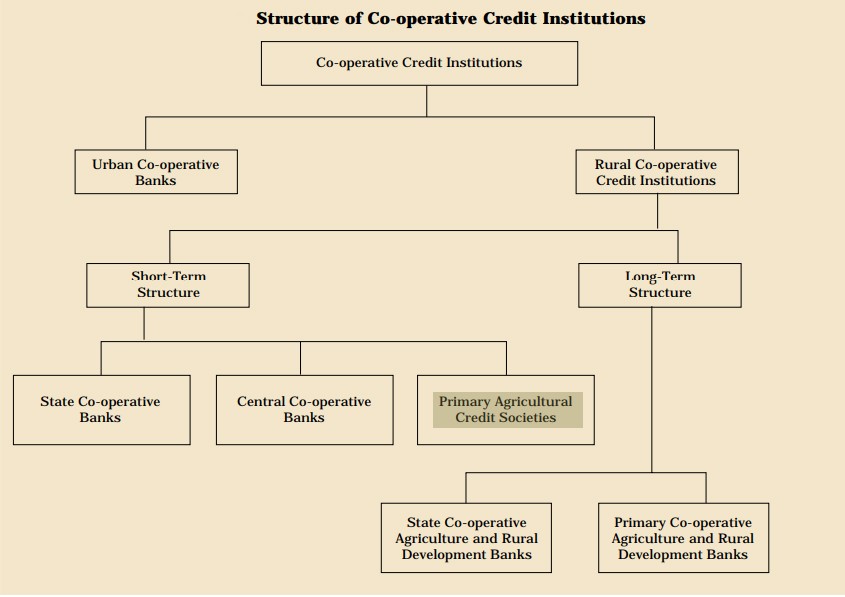
At present, there are currently 33 state cooperative banks (SCBs), 328 district/central cooperative banks (DCCBs) and 1.01 lacs functional primary agricultural credit societies (PACSs) in India.
2025 has been designated the International Year of Cooperatives by the United Nations. The theme for 2025 is “Cooperatives Build a Better World”, highlighting the transformative role of cooperatives in promoting social inclusion, economic empowerment, and sustainable development. The official launch of the International Year in India took place at the ICA Global Cooperative Conference and General Assembly in New Delhi, in November,2024 by our Prime Minister Sri Narendra Modi and a commemorative postal stamp has been released.
Each year, first Saturday of July is celebrated as “International Cooperative Day”.
Of late, the Government of India has taken several initiatives in approving the Plan for strengthening Primary Agricultural Cooperative Societies (PACS) and deepening its reach up to the grassroots. It aims at bringing greater transparency and accountability into their operations and enabling them to diversify their business and undertake more activities. These will enable PACS to diversify their business activities by undertaking more than 25 business activities, including dairy, fishery, floriculture, setting up godowns, procurement of food grains, fertilizers, seeds, LPG/CNG/Petrol/Diesel distributorship, Fair Price Shops (FPS), Business Correspondent activities and Common Service Centers. To strengthen the PACS, the Ministry of Co-operation approved Computerization of 63000 functional PACS.
One of the Key initiatives taken by Government of India for strengthening cooperatives is to allow PACS to carry out the activities of Common Service Centers (CSC).
In 2015, IRDAI allowed CSCs to sell insurance products. In 2019, these Common Service Centers have been redefined by IRDAI as “Common Public Service Centers” (CPSCs). “CPSC” means the “Common Service Centre” established under Digital India Program of Government of India and implemented by M/s CSC e-Governance Services India Limited and includes similar centers established by the Special Purpose Vehicle (SPV) of respective State Governments. Therefore “CPSC-SPV” means the Special Purpose Vehicle of respective State Government incorporated to facilitate delivery of government, private and social sector services to citizens of India through the Common Service Centers (CSCs) network, and it includes who for remuneration arranges insurance contracts for specific products approved by the Authority with insurers on behalf of its clients and offers other insurance related services through CSC Network. Therefore, CPSC-SPV shall be an “Insurance Intermediary” under the Regulation. CPSC-SPV, on getting valid registration from the Authority to act as an insurance intermediary, may enter into agreements with Insurers. Under CPSC-SPV, a band of Village Level Entrepreneurs (VLEs) or Rural Authorized Persons (RAPs) will be authorized to solicit the approved insurance products after their successful completion of training and passing the stipulated examination.
Now PACS (CPSC -SPV) have the opportunity to partner with insurance companies to offer insurance products. These partnerships can involve the insurance company providing the products and the PACS acting as the distribution channel, reaching out to their members with the insurance offerings through VLEs/RAPs.
PACS (CPSC -SPV) would sell simple ‘Over the Counter’ (OTC) insurance products which mean the simple vanilla product wherein each benefit is predefined and disclosed upfront clearly at the time of sale and is simple to understand. Pre-underwritten products generated by the system of Non-Life Products and Life Products will be sold.
- The products of Non-Life Insurance that may be sold through this channel are Motor comprehensive insurance package policy and Third-Party liability policy for two-wheelers, private car and commercial vehicle, Health Insurance, Personal accident, Travel insurance, Agriculture Pump Set Insurance, cattle Insurance and Home Insurance.
- As to Life Insurance products, Pure term insurance products with/without return of premium, non-linked non-participating endowment product, Immediate annuity products are available.
- Micro Insurance products and Social Insurance products are also included.
- In addition to that, IRDAI is going to introduce an all-in-one affordable insurance product to provide basic social safety net coverage to rural households. It combines life, health, accident, and property insurance under one policy, making it accessible and affordable for a wider segment of the population.
PACS has a network of Members of approximately 12 crore farmers, which can be a significant asset in disseminating the benefits of insurance. Insurance Company may take initiative in sensitizing these members to increase the numbers of VLEs/RAPs.
The rural population is large and uninsured. A targeted approach to develop VLEs /RAPs of PACS for insurance selling depends on their qualification, interest and aptitude. Insurance companies may chart a growth path for VLEs /RAPs depending on their proficiency in insurance selling. This will help VLEs / RAPs in visualizing a better and more remunerative career in insurance selling and nudge them in learning insurance selling. Phase wise intensive training and a system for hand holding of VLEs /RAPs will go a long way in developing their insurance selling skills. Insurance portals in vernacular language will help VLEs /RAPs perform better.
Printed publicity material in local language may play an important role in helping people understand and create trust. It also creates feel good factor and people value it and find it worthy of keeping with them. Intensive marketing efforts of the Insurance Companies will increase the numbers.
By offering insurance, PACS can strengthen their position in increasing their income on the one hand and on the other hand a greater number of people are brought under the Insurance umbrella reducing the Insurance Protection Gap.
Let 2025, International Year of Cooperatives be the onset of PACS to become an effective Insurance Distribution Channel.
Authored By:
Paresh Nath Karmakar
Retired DGM(IS): United India Insurance Co. Ltd.
Ex-Faculty Member: National Insurance Academy, Pune and College of Insurance, Insurance Institute of India, Kolkata
