



The ejusdem generis rule states that the meaning of any general term depends upon the specific words that go before it. The ejusdem generis rule is a construction principle based on context. It provides that general words that follow particular words refer to things of the same kind’ (‘ejusdem generis’) as the particular words.
In the earlier MALGUDI days of RK. Narayan, when people wanted to go for a festival shopping, they needed to travel to different markets situated at different geographical locations -sometimes even to another town, by spending more time and money. Now time has changed, and one can complete the entire shopping at a single shopping mall saving all the time, energy, and money.
Buying insurance in India is still in MALGUDI days model only. If I want to buy multiple insurance policies viz., Life insurance policies, Investment policies, Motor insurance for the two or three Two-wheelers and one or two cars of my family and health insurance policies for my parents, in-laws and for my own family-I need to visit nearly half-a-dozen to ten insurance companies of life, General and health. I need to repeat the same exercise at the time of renewal also by investing more time and effort.
However, thanks to the new initiative by Insurance Regulatory and Development Authority of India (IRDAI), this tedious job of buying insurance is made simpler with the introduction of a concept called BIMA TRINITY- a game changer and a revolution in the entire buying process of insurance in India. It is a part of a broader campaign called “Insurance for All by 2047”- under mission Viksit Bharat of Government of India.
Backdrop:
Currently the insurance Penetration in India stands at 3.7 % of GDP (FY 2024-IRDAI Annual Report)- as against the global average GDP of 7%.
The reasons are many, but few are mentioned below.
- Wrong selling of Life insurance products by Agents without explaining full benefits to the customer.
- Forced selling of insurance policies by banks without the consent of customer.
- Wrong positioning of the products like ULIPs as investment products.
- Unprofessional selling by Brokers -not taking the consent of the buyer before selling the product.
- Costs overweighing the benefits in health insurance products- Premiums go up every year above the inflation under individual health insurance policies.
- Escalation in legal complaints under Claims servicing in health & life insurance.
These issues were discussed in the recently held 9th Bima- Manthan meeting conducted under the aegis of IRDAI chairman & CEO Mr. Debashish panda with CEOs of all insurance companies (Life, General and Health) participated in it. The meeting has resolved to achieve the mission of fully insured India by 2047, through implementation of several reforms inter alia, to ensure inclusive growth, to increase insurance Penetration, to create a robust insurance infrastructure and to promote Insurance literacy.
The goal is to make insurance more accessible, affordable and efficient by advocating transition from a traditional rule- based regulatory system to a stakeholder friendly principle- based system using disruptive techniques.
Important initiatives are:
1. Free hand is given to insurers to decide on remuneration to their distributors, but within the overall cap set by the regulator.
2. To increase FDI to 100% to welcome Global Players into insurance.
3. To Enable insurance agents to have licence from more than one insurance company from all the three categories of insurance.
4. To reduce the minimum capital requirement to 50 Crores for companies to enter the insurance industry.
5. To create a platform called BIMA TRINITY where one can get everything related to life, general and health
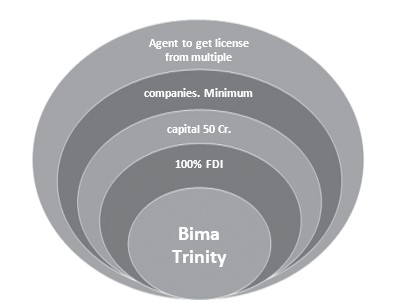
Transition from Rule-based to Principle- based Regulations
The objectives of BIMA TRINITY are:
1. To design user friendly products within affordable
2. To simplify the process of insurance distribution
3. To promote single-window post sale
4. To ensure Inclusive growth of left out segments in urban and Rural India.
The THREE key components of BIMA TRINITY are:
1. Bima Sugam
It is a unified public digital marketplace that simplifies the process of selling, servicing, and settling Insurance claims. It brings together different insurance companies under one digital roof, offering consumers a seamless buying experience, making insurance more user-friendly and efficient.
Features:
I. The policyholders do not require to visit multiple sites/ places to buy insurance or to get service. insurance would become predominantly a digital product just like a bank product/ mutual fund.
II. It helps customers to buy a suitable product out of many They can compare the prices/benefits and make purchase decisions.
III. Customers can manage their policies across life, health, and general on one platform.
IV. The distributors are benefited immensely by selling the products with lesser price and in lesser time.
V. Customer need not give physical Identity proof under KYC norms as it gets auto populated through Aadhaar as Bima Sugam is connected to the server.
VI. Customer can make the premium payment through UPI and once the payment is successful, the companies can immediately issue digitised policy with quick underwriting machines.
VII. The speed in issuance of polices makes the sales more efficient and helps in increasing the remuneration of the distributors.
According to Mr. Satyajit Tripathy, Member – Distribution- IRDAI, the Bima Sugam will transform the insurance sector just as how the Unified Payments Interface (UPI) has transformed the payment system and banking sector in India.
2. Bima Vistaar
Bima Vistaar is a composite (single) insurance product offering comprehensive protection against the risks related to life, accidents, property, and hospitalization. This reduces the difficulty of managing multiple insurance products and making it an attractive option for many people.
3. Bima Vahaak
It is a women-centric initiative making them as local distributors for insurance in both Rural and urban areas. It not only provides greater access to insurance but also promotes financial inclusion and gender equality in the sector.
Summary of BIMA TRINITY:
| S.no | Name | Features | Advantages | Benefits |
| 1 | Bima Sugam | Single window insurance sales platform | A unified, open and digital platform for buying, servicing, and settling claims across all companies. | Easy to access all types of insurance products with easy accessibility and efficiency in service. |
| 2 | Bima Vistaar | Customer centric combo product design | A single product offering coverage for early death, accidents, property, and
hospitalization. |
a single policy with multiple insurance benefits. |
| 3 | Bima Vaahak | Gender inclusive distribution | A localized women-centric field-force to sell insurance in rural and semi-urban areas. | Ensures women empowerment & financial inclusion. |
This initiative by IRDAI becomes a game changer in the insurance industry. It helps the insurance buyers in searching at a single platform for a comprehensive Combo insurance solution ranging from Household insurance to health insurance to family protection insurance. As women are included in the insurance sales under Bima Vaahak initiative, it is easy to increase the rural penetration of insurance products in India. It also suits to the emerging GenZ population in buying insurance through digital platform.
However, there are some challenges like the negative impact of these reforms which needs to be addressed.
Points to ponder:
- Some Indian companies may exit the insurance business by selling their stakes to foreign companies with increase of FDI to 100%.
- The composite licence may be mis-used by unprofessional intermediaries by compromising the customers interest, as here two contradictory businesses viz., life and non- life are brought under one roof.
However, every reform will have its initial hiccups but ultimately take us to the expected goal with the wholehearted support of all the stake holders in this context, all the insurance companies.
Authored By:
Prof. ESNB Srinivas
M.Sc., MBA, FIII, PGDCS, FCOT.
Assistant Professor -Senior Scale at UNext-Manipal Academy of BFSI –
Bangalore Campus
