


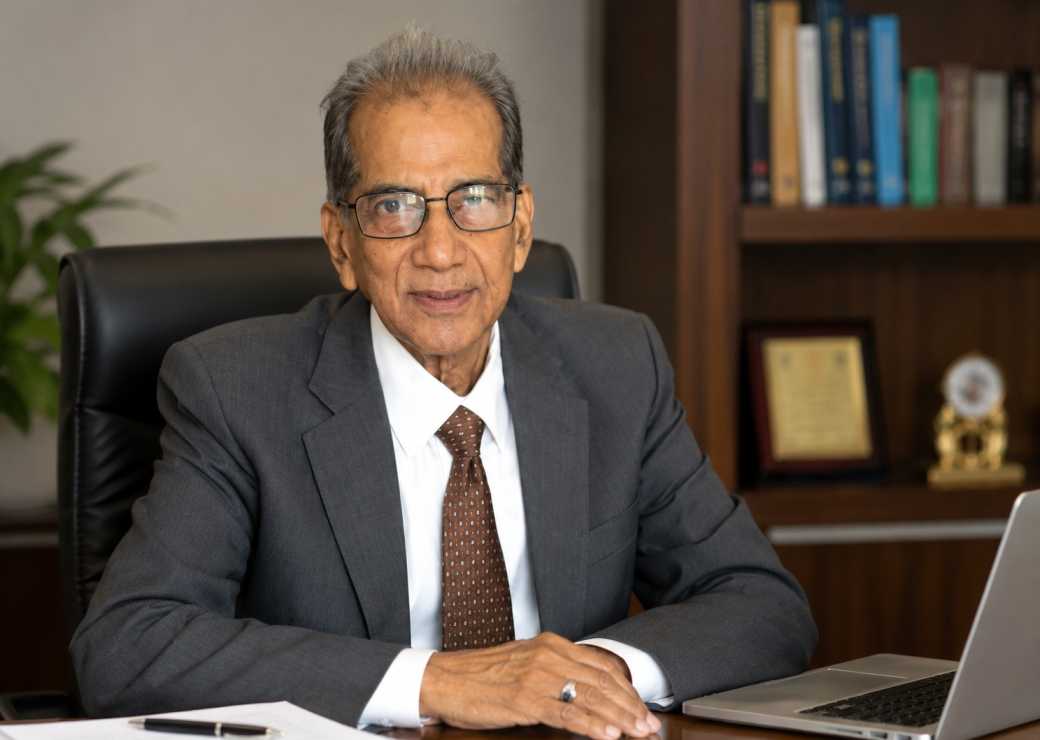
About Mr. B.D. Banerjee
At 84, Octogenarian Mr BD Banerjee remains as fit as a fiddle. What began as a stroke of serendipity evolved into one of the most distinguished careers in Indian General Insurance. A member of the third batch of direct recruit officers at LIC in 1964, BD — as he is affectionately known — was among 89 Officers selected after a detailed process of selection. Following a mandate to train 72 trainee officers exclusively in the General Insurance stream, by the LIC’s Central Office, the legendary Prof D. Subramanium, Principal, of the Officers’ Training College, Nagpur, announced that 17 officers would be assigned to the Life Insurance Section through a lottery. Banerjee was not among them. Initially crestfallen at not receiving a conventional LIC training, he found reassurance in the prophetic words of a distinguished Faculty member, Prof Chatterjee: “Mark my words, general insurance will also be nationalised, and you all would be the 1st Batch of Senior Officers by then” That chance assignment became the defining turning point of his life.
His journey began in 1965 at the Jalpaiguri DO of LIC, where he was entrusted with launching the general insurance business Wing for LIC (GI). From those modest beginnings, he rose steadily through the ranks with remarkable distinction — eventually becoming Managing Director of GIC and later Chairman-cum-Managing Director of The Oriental Insurance Company Limited. He also held the additional charge of CMD of National Insurance Company Limited, a rare dual responsibility that reflected the immense trust reposed in him. Post retirement, he was Administrator, Pune Stock Exchange, an Insurance Ombudsman for Mumbai, covering Maharashtra and Goa. He also served as an Independent Director on the Boards of BOC (India), Tata Rallis, Tata AIG and Royal Sundaram General Insurance Cos. He was also a Member of the Technical Committee and Consultative Committee of IRDAI.
A Philosophy Honours graduate from the prestigious Presidency College of Calcutta in 1960, he earned his Master’s degree from the University of Calcutta in 1962. Before joining the LIC, he briefly served as a Lecturer at a College, teaching Logic, Psychology, and Philosophy. Quintessentially a Bengali bhadralok, Banerjee nurtures a lifelong passion for classical music and Rabindra Sangeet, and is a good singer, having participated in quite a few shows. As a Trustee on the Board of Trustees of ‘Prangan Foundation’, Mumbai, he has worked tirelessly to popularise Bengali culture and Tagore’s music among non-Bengali students and audiences. Singing and Cricket remain his enduring personal passions.
Another defining phase of his career came in 1988, when he joined GIC. As a young officer serving in the Coordination Department, he had the privilege of observing the respected Seniors and even interacting with stalwarts from all four general insurance companies — experiences that deeply shaped his professional vision and aspirations. A widely travelled person, Mr Banerjee led the teams at GIC in Tokyo and Miami, and at Oriental’s in Paris and London for negotiating specialised Insurance packages. Equally admired for his intellectual depth and teaching prowess, Mr Banerjee has also served as a visiting Faculty member at the National Insurance Academy, Pune, Goa Institute of Management, Goa and the Indian Institute of Management, Nagpur, leaving an indelible mark on generations of insurance professionals. In 2017, Birla Institute of Management Technology (BIMTECH) honoured him with a Lifetime Achievement Award in recognition of his outstanding contribution and distinguished service to the insurance industry.
In a lively tête-à-tête, he shared his insights and experiences with Dr Abhijit K. Chattoraj.
1. In your view, how has the Indian insurance industry, especially non-life insurance, evolved over the years, and why does penetration continue to lag behind global benchmarks despite this growth?
BDB: I will handle this question holistically, as I shall touch upon ‘Life’ Insurance also. The cardinal issues in “INSURANCE’’ are a) ‘awareness’ of risks around us, b) ‘uncertainty’ in their operations in our daily life and activities and c) ‘creating’ or ‘accentuating’ an ‘emotional’ relationship to protect life and livelihood, to reduce, thwart or prevent the impact as far as possible, at an affordable cost. This is true of men and matter, and so the assets and properties, together with ‘life’ and ‘sustainability’/continuity in operations, become a stake for protection. People in the business need to be fully aware of, educated in, and convinced of not only taking cover but also propagating the need for such protection.
Over the years, following the opening of the Market to Private competition, the entry of foreign companies collaborating with Indian partners has substantially enriched the market across all areas of operations. To adapt to the changing environment, improved know-how, aided by technical competence, in business acquisitions and distribution has contributed to growth. With digitisation and stiff market competition, business has been growing steadily with multiple options for accessibility and choice of Products. Hence, no wonder the market has expanded substantially, driving it to Rs 3.5 lakh Crore in Non-life and well past Rs 4.5 lakh Crore in Life Insurance segment (2025-26-Source: Life and General Ins Councils) with an approximate compounded growth rate of around 9-10% overall. India’s share in global insurance premiums is 1.7%, and its overall ranking is 10th, with Life Insurance at 9th and non-Life at 14th (Source: Swiss Re Report). There has been steady growth in New Business and Policy issuance in the life and non-life Insurance segments, as the final figures are being collated at IRDAI.
Yet the discordant note is that Insurance penetration to GDP remains flat at 3.7% as per 24-25 figures, Life Insurance accounting for 2.7% and non-Life flat at 1%. As per the Swiss Re World Insurance Report, Global Insurance penetration is 7.3%, with life at 3% and non-life at 4.3% in 2024-25. Personally, I am not unduly worried about this issue, as various factors guide the linkage to the GDP, and without dilating further, I would mention some critical issues in penetration that would be representative of the overall scenario. Issues like risk-based premium rates and resultant volumes, policy size, wider coverages in Fire and Machinery Insurances with adequacy in sum insured, sales of small policies to SMEs, MSMEs, mass coverages in Rural areas, and all-risks Policies would substantially increase the figures. What is needed, then, is to build a larger base for rousing awareness, augmenting emotional attachment, providing wider and fuller value coverage, with higher sales of Personal lines and Accident Insurance, less-propagated Loss of Profits Insurance, etc., with an adequate rate structure to substantially increase penetration as well as GDP linkage.
2. How do you view the current transformation underway in the Indian insurance industry, particularly in terms of regulation, competition, and market dynamics?
BDB – Indian Insurance Industry, since opening to competition, has undergone a metamorphic change in my view. Right from business procurement to processing and execution, through technology adoption, innovative product design, customer-centric adaptability, and servicing, the sector is now in a dominant position, making its mark in the global arena. Regulations embracing Technology, Bancassurance, Online sales, Mobile-based servicing, E-commerce, Fintech, Embedded Insurance, Micro-Insurance, Highway sensing and Real-time claim settlements through technological advancement, guiding and controlling the intermediaries and connecting with the service providers through various contact points– Insurance Sector has now travelled a distance to become a treat to watch and avail of.
All these have been possible because of the exemplary role played by the Indian Insurance Regulatory and Development Authority (IRDAI) and the regulations and reforms it has put in place over the years. Without going into the various reforms and changes, it may be asserted that, from the entry point to the conduct of business and market operations, the Regulator has shown greater responsibility in directing companies to be customer-centric, market-based, and growth-oriented. There cannot be any issue that has prevented the companies from being more productive and innovative, or from answering business needs that have not been addressed through regulations and reforms. With greater access to Insurance protection, customer expectations driving innovation, product fine-tuning, and a customer-centric approach, made up for the entire gambit of market dynamics. The availability of comparable products has driven intense competition, and, combined with competitive service levels, it has made the market resilient. The same is true of acquisition, distribution, delivery, and settlement of claims in both Sectors, which have brought about a sea change in the Indian Insurance Sector. At the same time, I feel the Market Regulator has to ensure business discipline to help Cos build on the evolving market expectations and resilience.
3. What strategic steps should insurers take to achieve sustainable growth while maintaining underwriting discipline and profitability?
BDB: The key to growth and sustainability of the Insurance Sector is the ‘underwriting’ and pricing of the risk with its full impact and ramifications at a given time and over a period. Assessment of the potentiality, or rather vulnerability, of a risk is the most important and pivotal issue in maintaining healthy growth and gradual capacity building for a risk-bearing Agency, that is, an ‘Insurance’ outfit. With my long experience in the field, and I am sure, most of you must have had the same experience, realised that when there is any opportunity of ‘’comparable services” with availability of similar products with options to choose the Provider, people would ask for lower ‘pricing’, higher coverages to buy that service and create a ‘Buyers’ Market’. The obvious result would be pushing sellers to a point where they are forced to sell the Products at a lower price, with ‘freebies’, or both, which would ultimately be uneconomical, non-viable, and non-sustainable over time. Pricing goes with an intrinsic assessment of risks/claim potential associated with the insurance offered and the contingencies chosen for coverage. The basics, those are followed, would be the intrinsic risks evaluation plus their probable return/repeat on a shorter/ longer-term and the potential of vulnerability and possible impact on our life/activities. Based on this, a small margin is added to cover reasonable administrative costs, plus an element of profit, to determine the pricing of the Insurable Risks. These steps are forgotten, and the entire mechanism is now missing, except, may be, for some FACULTATIVE Insurances on a case-by-case basis where Reinsurance and Reinsurers are involved. Even a few years back, there was a concept of a ‘burning cost’ in the pricing of some Risks, and a report used to be placed before the Board of Directors for information, as mandated. This has been discontinued, and I feel it has been to the detriment of vulnerable risks getting properly evaluated.
In Insurance Organisation, ‘UNDERWRITING DISCIPLINE’ should be synonymous with the system itself, and, if followed in letter and spirit, profitability would be a natural outcome. If ‘Risk-based’ Capitalisation of Cos is an essential requirement, it becomes ‘ ipso facto’ true that premiums should also be ‘risk-based’. I personally feel that an Underwriting Audit should be a mechanism within the IRDAI, comprising a very competent Team of Officers with adequate capability to conduct an underwriting audit at least once every 3 years, even selectively, to send a strong message to restore market discipline and the viability of the Units.
4. What is your perspective on the evolving role of public sector insurers in today’s competitive and technology-driven environment?
BDB: LIC of India, then as a monolith Life Insurer and GIC of India with its four subsidiary companies, viz, National, New India, Oriental and United India Insurance Cos were transacting Life and General Insurance Businesses respectively in India and as an important measure of REFORMS the Market was opened to competition in 1999-2000, with Indian Cos forming Units in collaboration with Foreign Cos as a Joint Venture to compete with the Public Sector companies. The Indian Insurance market, being a government monopoly, then became most vulnerable to attacks and lost market share to its existing businesses. In the Life Insurance business, there was no issue of ‘snatching’ or sharing as such, but in non-Life, fragmentation made it extremely vulnerable, and they started losing their grip on existing portfolios. Of course, there was significant development and an increase in market size, which remained anybody’s grab. Decidedly, the PSU Units did not do well on the face of fierce competition for various reasons —legacy issues and the baggage of large operations across India being supreme. The eroding business volumes of PSU companies were critical to their operations and ultimate viability, given the huge manpower and establishment costs. However, New India Assurance Co, the largest General Insurer in India, was doing well and became a Listed Company, with around 15% of its shares sold by the Government to the Public. There was a proposal to merge the other three Companies but the Government had decided to infuse fresh capital into the three companies to make them operational, stronger, and gradually prove their profitability. I must say that these three companies are doing well despite significant constraints and other issues embroiled, and I understand that the Government has also recently appreciated their performance at a Review Meeting, as the 2025-26 performance shows.
My understanding of the role being played by the Public Sector Companies- life and non- life, is reasonably good. LIC has been technology-driven since the early sixties, and as gradual changes have occurred, it has adjusted and upgraded very well. We should not forget that Computerisation was done in LIC much earlier, with the reorganisation and regrouping of Zonal operations and O & M Studies by Specialists in the 70s and 80s. It is an ongoing process and has steadily moved forward, as the results will prove, with LIC still retaining around 56% of market share against 24 Private Cos. PSU Gen Ins companies are also no ‘push-overs’—as all the companies are fully computerised and digitally savvy. Operationally, the companies are competitive and wherever there are gaps, improved technology support is being made. In my view, the issues ailing the Public Sector Gen Ins Companies are spinning off from a huge network, manpower, bad businesses with huge loss potential, carrying on with successive staggering underwriting losses, huge provisioning of claims with long-tail liabilities, escalating operating costs, wage arrears on revisions and also governance issues not being robust with truncated Board representations and governance. However, there is a noticeable change in the three PSU Cos in rejecting ‘bad’ businesses, pruning Loss-prone accounts in Health and Motor Insurances, and aiming for faster settlements/ review of age-old claims to reduce outstanding losses to be viable. A look at the Business Statements this year will show that a company has consciously written a lower volume of business than it did last year due to rejections. We may say that Public Sector Insurance is doing reasonably well and is poised for viability, keeping pace with much-needed technology support, reducing operating expenses to align with the sector’s growth potential and profitability.
5. How is digital transformation reshaping the Insurance business model, and what should insurers prioritise to remain competitive?
BDB: Like Banking, the customers of Insurance services expect and demand digital services across all processes, proposals, policy documents and claim settlements. It is the digital integration of an insurer’s entire operations, from underwriting to product development and claims processing to customer service, in a seamless integration that would be a desirable Business Model.
Several factors are driving the need and demand for ‘Digital Transformation’ of Insurance services, and the key factors are to stay relevant amid a competitive market. Indeed, the traditional Insurers are finding it difficult to shift gears to stay focused and competitive. Obviously, the first issue would be achieving operational efficiency in the conduct of business. The resultant effect would be to gain cost-efficiency in operations. It would also spur “innovation” by designing new architecture for the entire Insurance Product-cum-servicing, Product innovation, claims servicing, and settlement procedures without hassles. Typically, the cost structure of the Digital operations would reduce overheads and even with a high claims scenario across Motor and Health Insurances, the model would be cost-effective and competitive to stay in business. Digital model will also ensure fewer extraneous interruptions like market volatility, unpredictable interruptions through geo-political upheavals and the like.
Digital transformation is now a business imperative driving growth, efficiency and competitive differentiation across the Insurance Industry. In my view, as there are legacy issues, need to upscaling the workforce with higher productivity with new technologies would be important. So-called ‘Leadership inertia’ has to be shrugged off to adopt full-scale digitisation and conduct business. I would sound a note of caution here, to mention that in the Digital model there could be a limited scope for ‘need analysis’ to get the Proposer’s Financial status and suggest appropriate ‘Life Insurance’/ ’Personal Insurance’ needs by an Insurance Advisor to recommend appropriate Policies. The resultant effects are two-fold: mis-selling and non-renewal or continuance which is known as loss of ‘persistency’ or ‘non-renewals’ in Life and non-Life business. Devoid of real-time discussion combined with low financial literacy of the proponent may be a big void in Insurance awareness, resulting in after-sales woes and huge lapsations. I would recommend a “mix and match’’ model for operations as per the demands of business covering with a bit of personal touch, processing of Products, pricing, execution and documentation for profitable operations.
6. What are the key priorities for the Indian insurance Sector over the next decade to achieve higher penetration and long-term stability?
I have discussed this issue in passing while discussing awareness and penetration of Insurance in India, but it is more direct and warrants an in-depth discussion. “Insurance for All by 2047” is a visionary Project of the IRDAI. This aims to ensure that every citizen has adequate life, health and property insurance, and that every enterprise has access to suitable risk protection. A spontaneous response would be an increasing ‘awareness’ through digital networking and reach, transparency in business like Products explained in simple language, available at an affordable cost and making it accessible to one and all. Insurance accessibility has to increase significantly through a combination of both physical presence and intermediary expansion. Similarly, the distribution network also has to expand. A Government report suggests that it has increased from 48 lakh in 2020-21 to nearly 83 lakh in 2024-25. Rural access can be increased through Gram Panchayets and other Opinion Leaders to align with the Government’s “Sobka Bima, Sobki Raksha” or Insurance Amendment Laws 2025. It runs parallel to the objective of “insurance for every hearth and home,” which resonated with the Nationalisation of Life and General Insurance in India in 1956 and 1972, respectively.
I have a viewpoint on achieving higher penetration and stability, and that is the ‘personal’ touch element, which may be missing in a fully digitised environment, as I have stated already. Again, because of many factors, including personal gain, mis-selling happens more often. Such Policies are not renewed in non-life, and instalment premiums are not paid in “Life insurance,” resulting in huge lapsations. Also, as I see it, I feel leaving it for the people to read and respond, at times, may be leaving it to their judgment without proper explanation of the need, efficacy, and benefits associated with the product. Buying is always an “emotion” and harping on it properly may be missing in campaigns, digital or otherwise, highlighting the very essence of having adequate protection from risks that may affect us and our daily lives. I recommend an interface even remotely with the buyers at a given time. This would ensure both higher penetration and sustainability through judicious risk management.
7. What factors have prevented insurance in India from becoming deeply embedded in the mindset of the common people, and what measures can be taken to expand its reach across the country?
Let me be personal here. I am blessed with the rare privilege of starting my career as a Junior Executive and working for more than four decades in 5 Units out of 6 Units of Public Sector Cos, LIC, GIC, with its 4 Subsidiary Cos and still later, as Insurance Ombudsman, and what I shall be writing now would be experience-based and professionally verifiable.
1. On the face of it, Insurance Products are only promises that trigger on the occurrence of a contingency stated in the Policy. It is ‘abstract’ and not a ‘concrete’ something but an ‘assurance’ of a payment at a ‘distant’ future in case the ‘contingency’ affects us, and if it does NOT happen, no return of MONEY is made, and the entire amount is regarded as ‘lost’.
2. This feeling arises as the ‘awareness’ is NOT deep-rooted, and the eagerness to get protected at any cost is NOT felt. Hence, the NEED is to ‘incite’ the awareness and ‘perceive’ the risk in depth.
3. Insurance Companies’ credentials to stand up to their ‘promises’ are also not TRUSTWORTHY, as evidenced on the ground and heightened BY market perception. ‘Rejections’ are more than ‘acceptances’ and ‘settlements ‘to alter the feelings and justify the need for insurance.
4. As there is a reference to ‘common people’, I would mention ‘Personal Lines’ Insurances like Health Insurance, Vehicle Insurance, and other policies including Personal Accidents, ‘Householders’ Comprehensive and ‘All Risks’ Policies. I call all these ‘benefit-oriented’ Policies, where there is always an expectation of compensation, and here the ‘trust’ factor operates more, while ‘disputes’ lead to a lack of faith in Insurance Units. What we know as ‘word of mouth’ or ‘whispering campaign’ against companies for refusing to pay also does more harm to companies for their insensitive handling of claims/disputes.
5. A feeling that ‘this will not happen to me’ creeps in people looking for Insurance, especially Life Insurance and Personal Lines Insurance, and any amount of pleading makes them more adamant. The art of ‘selling’ such policies depends on rousing an ‘emotional’ acceptance of the rude reality around us day in and out, as we see news of accidents and disasters in newspapers, and also to project the image of ‘INSURANCE Companies’ properly, as ‘friends indeed and Insurance as a friend in need.’ Unfortunately, our salespeople across the country are not properly trained or attuned to such value creation.
6. There is low financial literacy among a large number of people, and the lack of direct contact in most such cases makes it more difficult to appreciate the genuineness of the approach.
8. What positive changes have emerged in recent years? At the same time, do you feel that the rapid spread of digitisation has, in some ways, distanced insurers from everyday customers? There is a growing perception that the much-valued human touch is gradually fading.
Among the positive changes, I reckon that ‘Awareness’ level has increased substantially since the opening of the market, and with more companies in operation, the spread has been much faster and broader. The next important change is ‘risk perception’ ability amid a host of ‘RISKS’ affecting us day in and out. Having seen many Natural Calamities, terrorist attacks, Aircraft disasters, Sea Voyages with unforeseen disruptions, Wars, and pandemics affecting the Globe, the NEED for protection against various ‘RISKS’ affecting our lives and livelihood has gone up substantially. In the recent War-like operations in West Asia, the withdrawal of “war risks” from Marine Hull Insurance sent shivers down the spine in the World Market.
On the second issue, I made my views known regarding the effects and efficacy of ‘DIGITISATION’. Following up, I made my remarks that insurance needs a ‘hand-holding’ and an endearing spirit within to be more meaningful. I feel that when exclusively entire businesses are ‘digitally’ accessed and done, there could be some areas of building an ‘affinity, a rare feel of ‘warmth’ missing through some personal touch. The remedy lies in treating Insurance Advisor as ‘family friends’ and our guide.
