


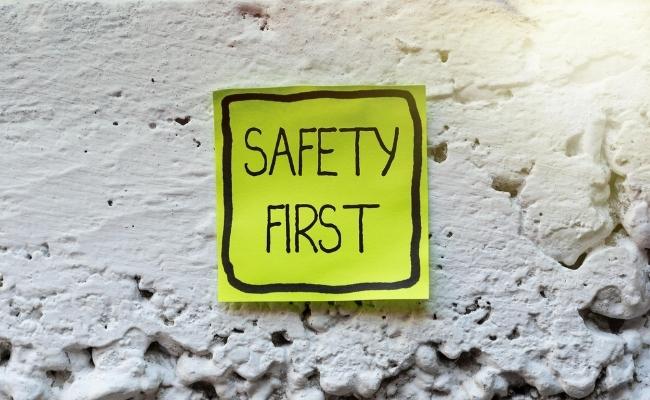
All these years, we have been fruitlessly searching for an elusive dream called ‘Safety’ in the most unlikely places, and our quest is maddeningly endless. Consider the following situations:
- We search for ‘safety’ at the red traffic signal. Any errant commuter would be fined by a representative of the government called the police.
- We search for safety in a helmet – whether a person driving a two-wheeler is wearing helmet or not? If not, a representative of the government is there, and we gladly pay.
Nowadays, even these representatives have given up fining. They watch these errant commuters helplessly. When people are not willing to learn, and are happy to pay, then what is the use of these helpless representatives? What is this term ‘Safety’? Where can we find this place called safety? How do we reach this place? We have been searching for ages; still, it remains elusive. The writing on the wall – Safety Tomorrow – seems to be true! Then the question that remains as usual is: Where is this place called safety?
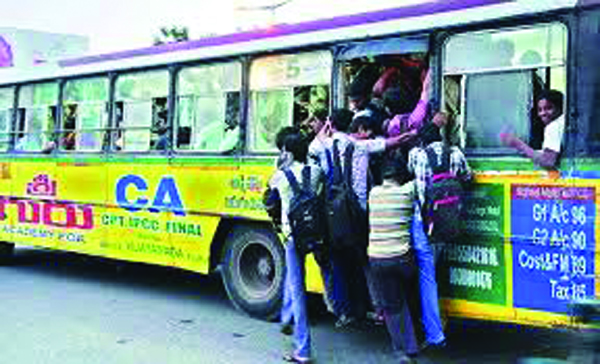 Any Road Transport Corporation (RTC) bus, when it crams 150 people in one bus, where majority of passengers are precariously hanging on at the footboard for dear life while clinging on to whatever they could find and in mortal fear, and where the bus stops suddenly without any warning or care for the others on the road, we call all this wonderful futile exercise glorious names such as a ‘service to the nation’ / ‘service to the people’ etc. So much so, we encourage this activity with free tickets to – let us say – half the population of India – Tamil Nadu, Andhra Pradesh, Karnataka, Telangana, Delhi, Punjab, to name a few states that provide this noble service!
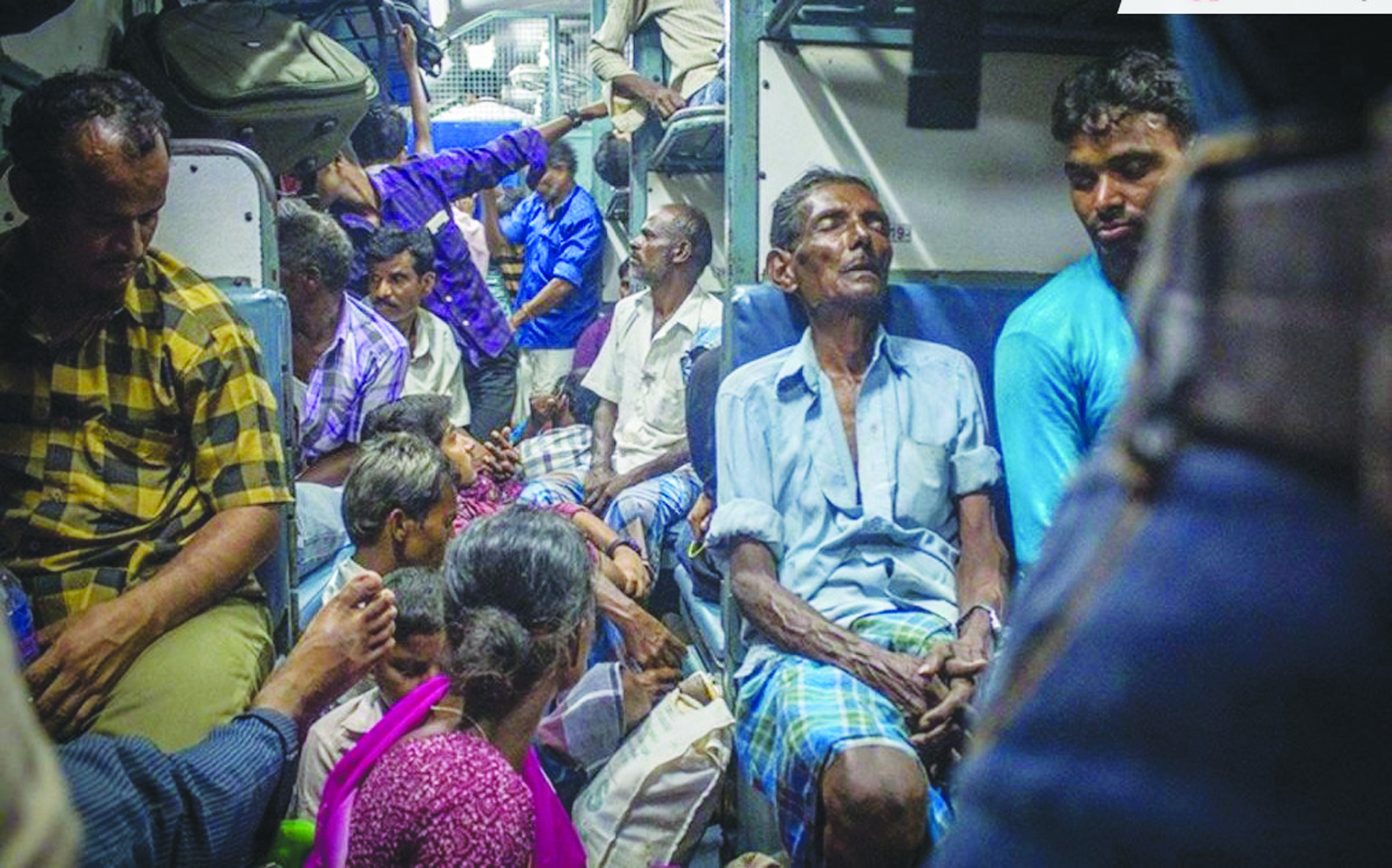
When a local train travels from one place to another within a city, the way people are crammed in those iron boxes is not only inhumane, but also against every existing policy of safety of the world. Many instances, or rather countless instances, where people lost their lives and limbs exist, yet we call this reason defying effort as ‘in the service of nation’. In the above two instances, we do not find anywhere a representative of the government enforcing the rules of safety or preaching a sense of safety to the people. The moot question, therefore, remains. Where is this place called ‘safety’?
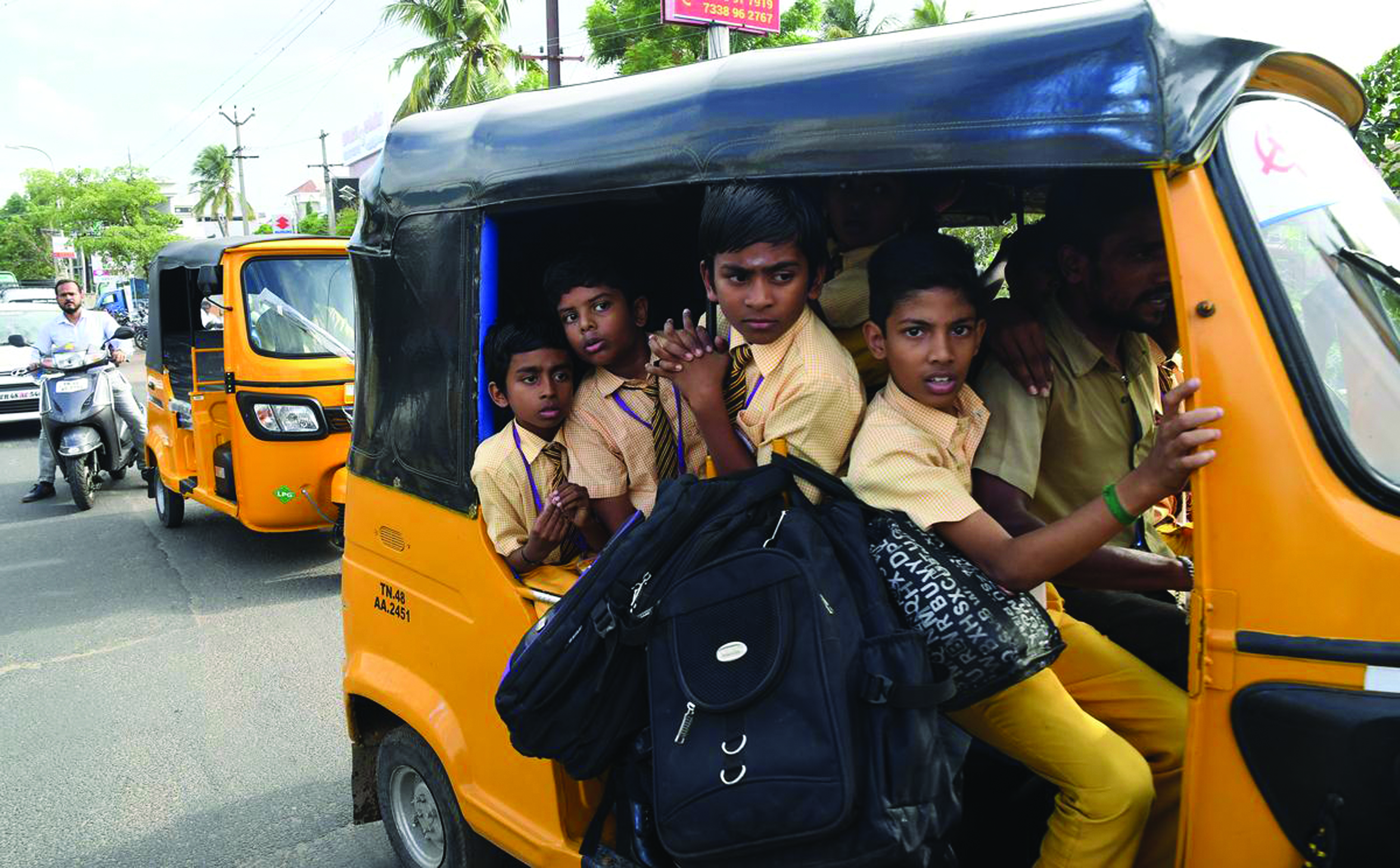 We are very proud of our Indianism. One should be. Why not? But we also express our pride in very many other wrong ways too! For Instance, an auto rickshaw carrying, in a pitiable manner, 25 school going children along with their school bags, crammed beyond human imagination into the auto rickshaw, we take pride in that and say ‘It only happens in India”. Safety cannot be ‘vehicle puja’ and expect the God to take care! What is happening? Where are we headed? Our singular question is, where is that place called safety?
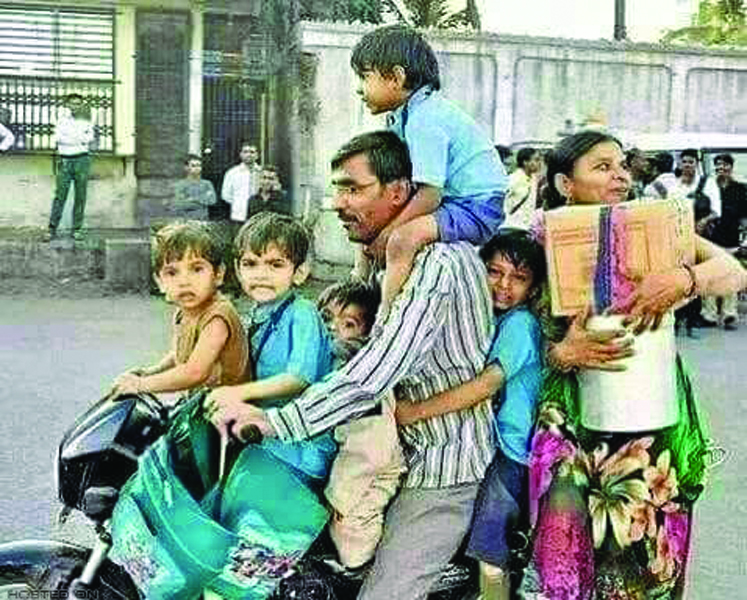 Parents and others make their children sit on a two-wheeler – four children besides the husband and wife, to drop them off at school. The two-wheeler rider follows every essence of law. He wears helmet, sits on the scooter the way he is directed by the law. The pillion rider and the four young innocent children, who are being transported to school, have no safety. They don’t have to follow the law. The law does not even exist for them. The only reality that exists for them is ‘Did we save few rupees on fuel?’ Pray tell us, where is this place called safety?
Law? We are not blaming the law. Why should we? We are not even suggesting a model law. In our opinion, law has nothing to do with the people and their safety. For example, Indian women dress in sari. A sari (or saree) is a traditional South Asian garment consisting of a long, unstitched piece of fabric (5-9 yards) draped elegantly around the body, worn over a fitted blouse (choli) and a petticoat, symbolizing cultural identity, grace, and tradition. We are talking of almost 90% of the Indian women who ride as a pillion rider on a two-wheeler. They cannot, by the very nature of their dress, sit in the manner they should sit on a two-wheeler. Sitting on a two-wheeler correctly means: sit upright but relaxed, grip the tank with knees, keep elbows slightly bent to absorb shocks, place feet on pegs with toes forward (or as appropriate for scooter/off-road), and keep the back with a slight curve for comfort and control, not ramrod straight. The body should feel integrated, allowing legs to hold the bike and free arms. But no saree wearing pillion rider could sit in the manner described.
The question is, how do we sit on a two-wheeler? Nowhere this is defined, not even in a two-Wheeler Insurance policy. Any discussion on this would make the emotions of the people fly high! Culture, tradition, Indian women etc., come in to unnecessary focus. Indian women wearing a saree on a scooter typically sit side-saddle (both legs to one side) for modesty and because it’s impractical to sit astride, often keeping legs tucked in close to the scooter, holding the driver or the seat, while managing the loose fabric (pallu) to prevent it from getting caught in the wheel. This position raises great many safety concerns. The chances of falling are higher in the manner they are sitting. Oh, it is our culture. How can you question that? It is not culture, but safety should be our only culture when we discuss two-wheelers. Then where is that place called ‘safety’?
You take the airports and the latest “Indigo fiasco” and the reactions of the people. If you were ever to travel on an airline, safety became a lip service. One can observe many violations of safety. Who is responsible for this? The government? Nah. The people? No. The law? Of course not. Then who is responsible? It has to be either everybody or nobody. Then where is that place called ‘safety’?
Seat belts are compulsory for our safety. We all wear seatbelts when we travel in our vehicles. It’s a good system. But where is the seat belt in a bus or seat belt in an auto rickshaw? Goods vehicles transport people and the vice-versa. Where is this place called safety? The scenario is confusing.
We, at insurancepe, don’t have any opinions of our own. We simply reflect society. We also reflect the millions who died, uncared, unsung. Had we followed the norms of safety in a place called safety, they would not have died prematurely.
Parents teach their children ‘it’s okay to travel four on a two-wheeler. Parents don’t mind if their child goes in a crammed auto to the school. But these very children do have a lesson about safety in their textbook, and they are expected to get a good grade by their parents! The police and other public agencies teach these young minds about the importance of safety. Often, you will see photos and news items in the newspapers and television channels about safety week. Is that safety? What is being taught in the school or by the agencies is vetoed a thousand times by the parents through their actions. When the attitude of the ‘Indian mind’ reigns, the sole question that is asked is ‘What mileage does a vehicle give?’ Safety and safety features remain elusive. Safety is a dream, rather a distant dream. For us, safety is always tomorrow.
All we talked here is about travelling and vehicular safety. Safety can be in our homes too – fire extinguishers. We borrow millions to build that sweet dream home, but we do not provide for a fire extinguisher in that dream home. No household in India is ever trained in firefighting. Where is that place called safety?
Let us also discuss industrial security. Many industries, we often read in the newspapers, have had the worst disasters. A great number of people die when every safety norm is violated. For example, the recent Goa nightclub fire; the Hong Kong fire; the fire in the chemical factory near Hyderabad; fire in the firecracker factory at Shivakashi. Where is that place called safety?
Pothole-riddled roads, overcrowded streets, desperate attempt to reach work or home fast. All this is fantastic. When everyone wants to go fast, nobody goes. When everybody moves; everything becomes immobile. Let us construct an illustration. We know the dimensions of every road in New Delhi or Calcutta. We also know the working hours of every office – when they open, when they close – every school, every bank and every other business. We also know how many vehicles are being sold a day! From the above, it can be easily stated at that given time how many vehicles a road can easily accomodate without traffic congestion. “It’s elementary.” It is easy to calculate. Yet we let many more new vehicles on the same road at the same time and blame others for this lax in safety.
We know exactly how many people can travel in a train from station X to station Z; and we also know how many people will get off at station Y. Yet we issue unlimited tickets at every station! Why? The crowds board the trains, the trains get packed, crowded with people often hanging on at the footboards. The doors of many trains won’t close. To close them, people cram themselves further, somehow huddled. The calculation is very basic. We can write a computer program, and we would have the result. We say this because when we can have an app for milk, groceries and every other kind of delivery, don’t you think it is a child’s play to construct a ticketing system for the trains which could manage all this? Yet we search for that place called safety.
Safety must exist in school and college buses. It does not matter if it does not exist in all those two-wheelers or other private vehicles which cram students. Safety must be, especially in this century, a way of life. We are in the same situation as we were, some 300 years ago, during the early stages of the industrial revolution in Europe. No value for human life, and absolutely no sense of safety. Whatever we have done and are doing may not be even a ‘foot note to safety’
Our attempt to reach the place called safety, through an insurance patent, is a small contribution towards the great work of many stalwarts. Our attempted contribution towards safety can at most be described as a ‘foot note to “a foot note to safety”’.
Through our patented insurance innovation, we are manufacturing articles of utility from insured salvage. An ‘article of utility’ can best be described as any piece of article which we use in our daily lives. They are the articles of regular use. These articles are manufactured from insurance salvage. On each manufactured article of utility, a QR code is engraved. We say engraved because it becomes inerasable. Scanning that QR code will lead you to the grim reality of the lack of safety which resulted in the loss of lives. Every important document/s from government agencies and from the insurer, authenticating the origin of the article of utility along with pictorial timelines is enshrined in our website www.bhadrat.com / www.insurancepe.com.
Let that article of utility be a guiding force, a constant reminder, and let it follow like a shadow not only the user but also his soul to always remind them not to commit to any hasty decisions to save few bucks or minutes more! Safety, is always first. It is not a norm; it is not a slogan; nor is it a rule. Safety first is a part of life; it is a way of life. Through this insurance patent, we aim to educate the public, to bring about a gradual change, to complete the insurance process of safety; to dispel the notion that insurers only care for profits and to attempt to save at least one person from an untimely accidental death.
We are not claiming, through this patented insurance salvage manufacturing articles of utility, that we are changing the world view on safety. It would then be a tall claim! But yes, we shall make a sincere effort with all the corporate houses to discuss the importance of public safety and how they could engage them, starting with their own employees. Let their Corporate Social Responsibility (CSR) funds be invested in these articles of utility, thus engaging all employees and their families in the process called safety. This is the place called ‘safety’. Let that CSR also adopt the safety of their employees, bringing much needed employees and their families in the engagement and acceptance of the truth of the importance of that place called safety.
About the Author:
Dr K. Rajagopal Reddy
PhD, FIII, FCII (UK), FLMI (US), FT
Chartered Insurance Practitioner
Topspot Insurance Broking Pvt. Ltd.
