



Context Setting
Nepal’s interest rate cycle has shifted rapidly in recent years—from peaks of 8–10% during liquidity stress to nearly 4–5% today amid excess liquidity. While lower rates support borrowing and economic activity, they create a very different challenge for life insurance companies.
At the core of life insurance lies a long-term promise: premiums collected today must grow over decades to meet future claims and guaranteed benefits. This model depends heavily on stable investment returns. When interest rates fall, that foundation weakens.
The paradox is striking premium volumes are rising, yet profitability is falling. The root cause is investment concentration. Unlike their South Asian peers, Nepal’s life insurers have limited access to alternate instruments — domestic bond markets are shallow, equity exposure is restricted, and infrastructure bonds remain nascent. The result is a sector that is simultaneously growing on paper and squeezed at the margin.
What appears to be a cyclical decline in interest rates is a structural stress test for the industry—forcing insurers to rethink its strategies for products, investments, and operating models for a lower-return future.
The South Asian Lens:
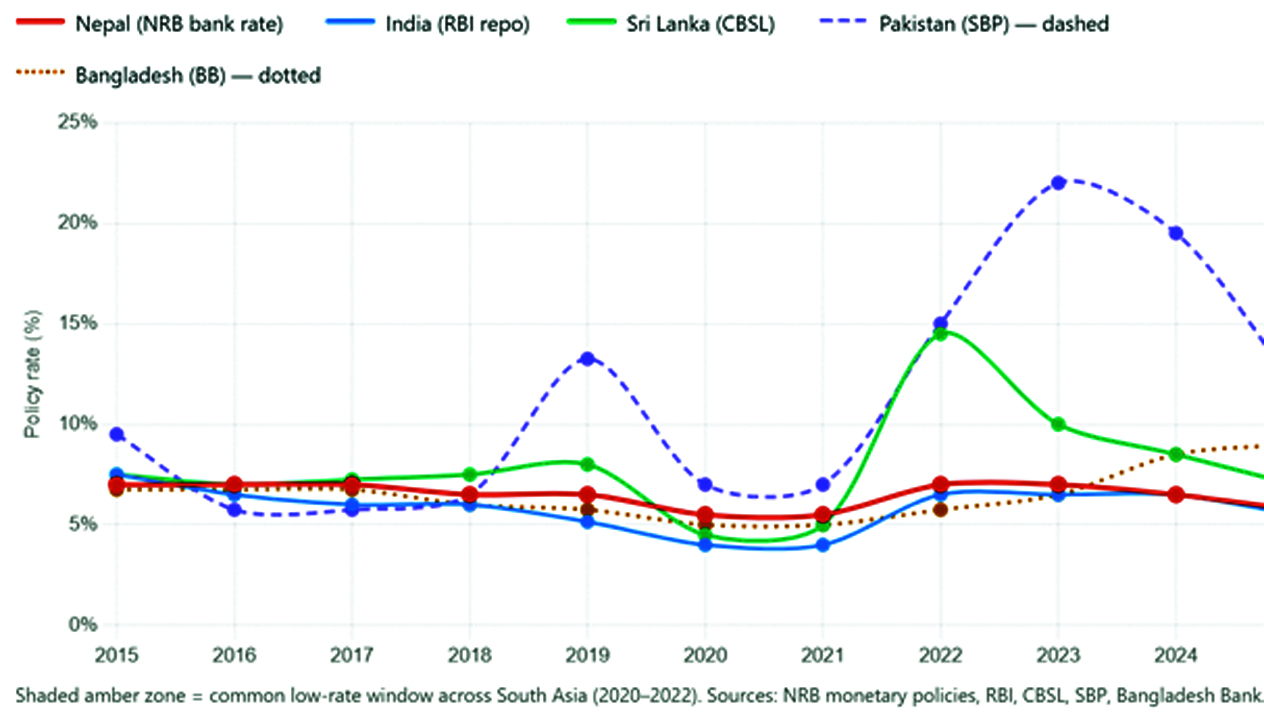
Across South Asian markets, interest rates broadly converged during the low-rate window of 2020–2022, with India (~4.0%), Sri Lanka (~4.5%), and Bangladesh (~5–6%) maintaining relatively stable and lower policy rate environments. These conditions enabled insurers to gradually shift toward diversified product mixes, including ULIPs and non-par offerings, while strengthening asset-liability alignment.
In contrast, Nepal exhibits a relatively higher and more volatile interest rate trajectory compared to regional peers. While other markets operated within a narrower low-rate band, Nepal’s rates remained elevated and less stable, reinforcing continued dependence on fixed-income returns and participating products.
This divergence positions Nepal as an outlier in the region—where higher historical rates have supported stronger bonus expectations but also increase vulnerability as the market transitions toward a lower interest rate environment.
Strategic Imperatives
1. Product Mix repricing & redesign
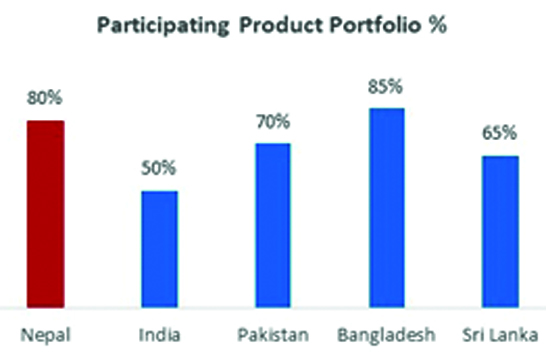
Participating in (par) products continue to dominate the Nepalese life insurance market, contributing nearly 80% of premiums and remaining closely linked to interest rate movements. As bonus payouts are largely driven by investment income and are not easily adjusted once declared, a prolonged low-interest rate environment creates structural pressure on sustainability. At the same time, growth expectations and evolving product features, including elements of guaranteed returns, add to the long-term complexity. This highlights the need to revisit product structures and pricing frameworks, ensuring that bonus expectations and guarantees remain aligned with sustainable, long-term investment yields.
Strategy: Focus Term Product, Explore ULIP, Product repricing, Revise bonuses based on return earned
 2. Investment diversification
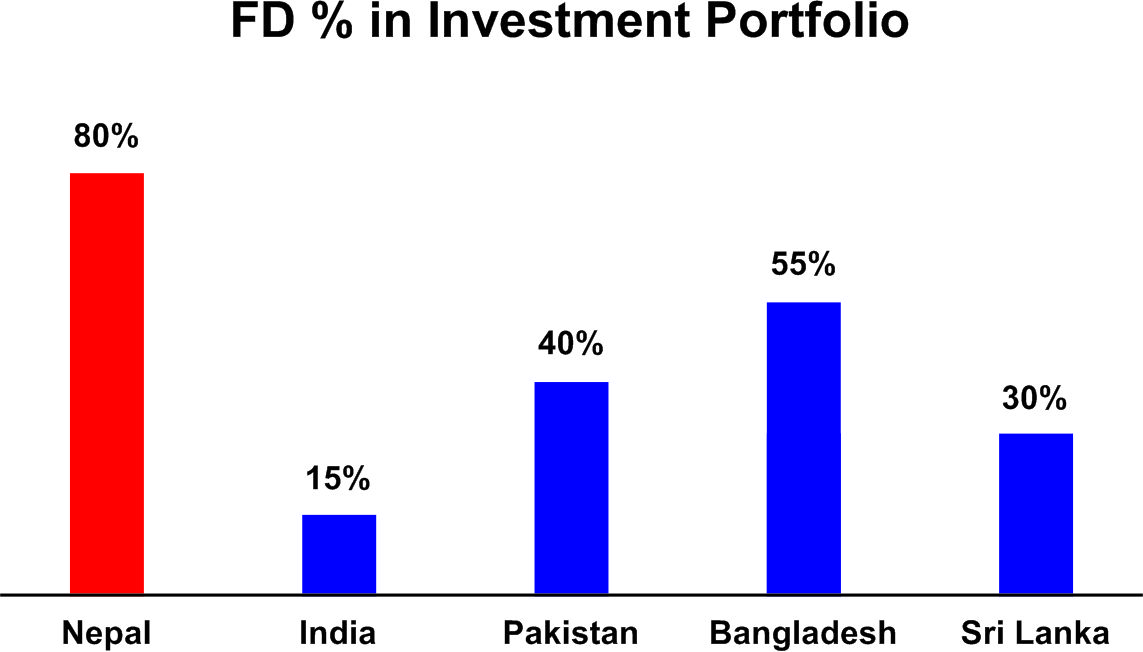
The high concentration of investments in fixed deposits—estimated at around 73–80%—highlights a structural constraint on return generation and interest rate risk management. Addressing this requires a gradual shift toward a more diversified asset allocation, including government securities & bonds, infrastructure and project bonds, and regulated equity exposure. Regional markets offer useful perspectives: insurers in India and parts of Southeast Asia have increasingly optimized returns through balanced portfolios combining fixed income with selective equity and long-duration assets, supported by strong asset-liability management frameworks. Such approaches not only enhance yield potential but also help manage reinvestment and interest rate risks more effectively. For Nepal, evolving toward a broader and more balanced investment framework remains key to improving long-term portfolio resilience while maintaining prudence.
Strategy: Reduce exposure to fixed income securities from banks, Diversify into alternate investments & government projects
 3. Asset-liability management
Life insurance liabilities are inherently long-term, typically extending 15–30 years, while most available investment instruments—such as fixed deposits and government securities—are concentrated within shorter tenors of up to 10 years. This creates a structural duration gap, leaving a portion of liabilities effectively unhedged and increasing exposure to reinvestment risk. Bridging this gap requires the gradual development of longer-duration assets within the financial system. Regional experiences, such as in India, demonstrate the role of policy and regulatory support in enabling insurers to invest in long-term instruments, including government-backed securities, infrastructure bonds, and public–private partnership (PPP) projects. Over time, the expansion of such investment avenues, supported by appropriate regulatory frameworks, can help better align asset and liability profiles while contributing to broader economic development.
Strategy: Assets with long term duration & security, Public private partnership model, ALM frameworks
4. Cost optimization & digitization
In a low-interest rate environment, operating efficiency becomes a key lever as investment income compresses. Nepal’s life insurance industry operates with a relatively high fixed cost structure, driven by branch-led and agency-heavy distribution, along with limited digital adoption compared to regional peers. This keeps per-policy costs elevated and reduces scalability. Strengthening digitization across onboarding, servicing, and claims can improve efficiency, enhance productivity, and support profitability—while ultimately delivering better value to policyholders.
Strategy: Reduce operating leverage, Cost optimization, digitization in various value chains, enhance productivity
5. Risk Management by balancing Growth and Risk
In a low-interest rate environment, strong premium growth—driven by higher bonus expectations and increased demand for protection products—can lead to rapid fund accumulation within the industry. While this supports expansion, it also creates pressure to deploy these funds efficiently. In the absence of sufficient long-term investment avenues, there is a natural tendency to move toward higher-yielding assets, which may increase exposure to credit and market risks.
At the same time, concentration risks particularly in areas such as reinsurance can further amplify systemic exposure within the industry. This underscores the importance of maintaining a balanced and well-diversified risk framework.
Strategy: Reinsurance outside the country, revisionary bonus rates, balancing risk with return
6. Capital & Solvency Management
In a low-interest rate environment, declining investment returns and rising liability valuations place increasing pressure on insurers’ solvency positions. As the value of long-term obligations rises while earnings compress, maintaining financial resilience becomes critical for long-term stability.
Strategy: Strengthen capital discipline, adopt conservative assumptions, conduct regular stress testing, and ensure adequate solvency buffers
 7. Customer Retention & Persistency
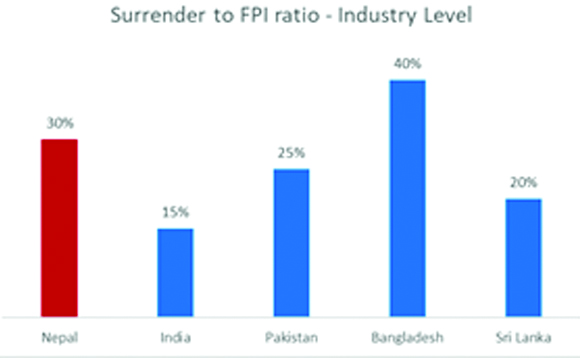
High lapse rates and early surrenders—often with low surrender values—highlight weak policy persistency in the market. In a low-interest rate environment, declining perceived returns can further accelerate exits, making customer retention a critical priority. Strengthening persistency through better communication of long-term value, improved service, and sustained customer engagement is essential to ensure stability and profitability. Regional experience suggests that even modest improvements in persistency can meaningfully support earned premium and partly offset investment income pressure.
Strategy: Improve persistency management, enhance customer engagement, simplify servicing, align expectations on returns
Conclusion: Adapting to a New Normal
The low-interest rate environment is not merely a temporary phase; it is a structural test of the life insurance business model. For Nepal, where the industry remains heavily dependent on participating products and fixed-deposit-led investment portfolios, the implications are significant. Yield compression, bonus sustainability, asset-liability mismatch, cost pressure, and persistency challenges all points toward the need for a more resilient operating model.
The way forward requires coordinated action across products, investments, risk management, and regulation. Insurers must redesign products with sustainable guarantees, diversify investments prudently, strengthen ALM practices, improve cost efficiency through digitization, and protect capital buffers. At the same time, policy support for longer-term investment instruments will be critical to help the industry match long-term liabilities with suitable assets.
Ultimately, the winners will be those who build businesses that are not dependent on high interest rates, but on disciplined pricing, efficient operations, prudent investment, and lasting customer trust.
“The solution is not to wait for rates to rise — it is to build businesses that do not need them to.”
Authored by:

CA Amit Kumar Keyal
Deputy CEO, Nepal Life Insurance
