


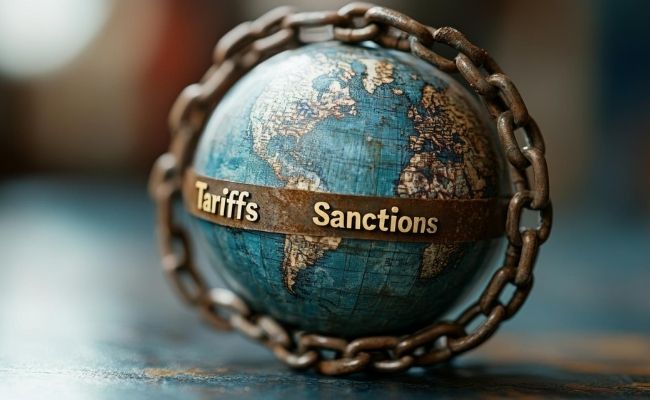
Even as the global reinsurance sector was reeling from the impact of the higher tari s announced by the US on imports from 57 countries in early April, the flare-up of the Israel-Iran conflict and the devastating Air India plane crash have put additional pressures on the business. While the world’s leading economy has since paused its ‘reciprocal tari s’ and continues to engage in talks with trading partners, economists have been warning of rising recession risks, which could derail global demand forecasts amidst rising cost escalations.
On account of the heightened geopolitical uncertainties, global businesses are already witnessing order cancellations, piling inventory and heightened credit default risks; especially a ected are those that rely on imported goods originating from conflict-ridden regions. As a result, insurance companies could see higher claim costs across lines, compelling reinsurance companies to recalibrate their underwriting and pricing strategies in response to the new insurable risks. Let us delve into the key reinsurance trends that are expected in the near term and their likely impact.
Higher Coverage
While the US asserts that its tari s are intended to strengthen its domestic economy, many industries, including insurance, are expected to face significant inflationary pressures. The 25 per cent duty on imported automobiles and auto parts will not only drive up the prices of new cars and replacement parts, but also negatively impact automobile insurance rates, as insurers factor in the associated cost escalations. Similarly, the decision to levy a 25 per cent tari on steel and aluminum imports will lead to higher construction costs, and larger insurance payouts across home and commercial segments.
What’s more, with repair costs rising on account of inflated material cost, insurers will also have to increase the coverage limits on existing policies. Apart from the resulting higher insurance premiums, insurers will also have to account for the increasing complexities and regulatory risks in public sector projects, ultimately forcing them to review and adjust their underwriting policies across most insurance segments.
Pricing Strategies
As the cost of capital goods and services spirals upwards due to the tari war, global reinsurers will have to adjust their premium pricing models for the automotive, property and casualty reinsurance segments, among others. Additionally, the fatal Air India plane crash has compelled reinsurers to re-evaluate risks associated with wide-body aircraft models like the Boeing 787-8 Dreamliner; this would harden the aviation reinsurance market and lead to stricter terms.
From an operational perspective, tari s on reinsurance-related services will increase the running costs for global reinsurers, especially for services and contracts involving cross-border deals. Consequently, reinsurers will have to model different loss scenarios, identify potential market dislocations and revise their premium pricing models on priority. Even in the unlikely event that the US settles for a flat 10 per cent tari policy for all its trading partners, reinsurers will have their work cut out in the near term as they assess and factor in the impact of the disruptions on the global reinsurance market.
Stagflation Worries
Within reinsurance, property reinsurance remains the largest and fastest growing segment, followed by casualty reinsurance covering liability insurance for individuals or corporations. In terms of regional market share, North America accounts for 34 per cent of the global reinsurance business, while the Asia-Pacific region remains the fastest growing, with a 17 per cent market share currently.
While the global reinsurance market was poised to experience a compound annual growth rate of 11 per cent between 2025 and 2032, the tari war could derail some of this momentum.
According to a Reuters poll, 92 per cent of the surveyed economists from 50 di erent economies agree that the tari s will have a negative impact on business sentiment, with 75 per cent alluding to a lower global growth forecast for 2025. As a result, reinsurers may have to contend with shrinking economic activity in the most extreme scenario, thereby underscoring the likelihood of reduced insurance demand and increased credit risks. This is especially true for price-sensitive reinsurance segments and markets like Latin America and the Asia-Pacific region. Consequently, reinsurers will have to devise new cost-efficient solutions to tap the emerging markets and help them sustain the positive growth momentum from 2024.
Digital Innovations
Recognising the need to go beyond traditional reinsurance solutions, many reinsurers have been innovating alternative risk transfer (ART) solutions to reduce risk concentrations and bring in more flexibility. Notable among these are the catastrophe bonds, insurance linked securities and collateralized reinsurance solutions. While the demand for such solutions was more prominent in countries with a high exposure to natural calamities, the tari war could spur reinsurers to accelerate the pace of new ART launches across different reinsurance segments.
Moreover, with tari -related inflation set to disrupt the North American reinsurance market, reinsurers are slated to focus more on the Asia-Pacific region to bolster business. Markets like India, Indonesia and Vietnam could see increased interest from global reinsurers, with the incumbent players expected to reap the most out of their growing insurance needs in terms of treaty and property reinsurance.
Notwithstanding the probability of further geopolitical tensions, the global reinsurance industry is expected to emerge relatively unscathed on the back of rising global demand. That said, reinsurers will have to realign their growth strategies to take advantage of all emerging opportunities, even as they double down on investments in digital tools and platforms to streamline risk assessment.
